Last night I never opened SketchUp

I typed in Telegram, one requirement at a time, and Claude Code built a unitized curtain wall. One floor-to-floor storey, detailed to 1:5, openable and fixed and spandrel panels all visible, fins, transoms, raised floor, suspended ceiling, a corridor-type double skin with louvres, a scale figure inside, and compliance with Hong Kong building regulations. Each time I added something, it rebuilt.
The surprise was not the speed.
It was that reading the codes surfaced two things I would have had to stop and think about myself.
First, that famous 900 mm spandrel. Clause C11.1 of the Fire Safety Code says plainly that it does not apply to a sprinklered building, and every Grade A office tower is sprinklered. So spandrel height is not set by fire at all. It is set by the raised floor, the slab and the ceiling void. What always applies is C10.2, sealing the void at the slab edge to under 25 m³/h/m².
Second, I only wanted a sectional model because it is easier to read. It turns out clause 8.3.1 of the Glass Code defines the statutory safety-test mock-up as at least two storeys high with an operable sash, at least three modules wide, with turning corners. The convenient thing I asked for was the regulatory object.
Second, I only wanted a sectional model because it is easier to read.
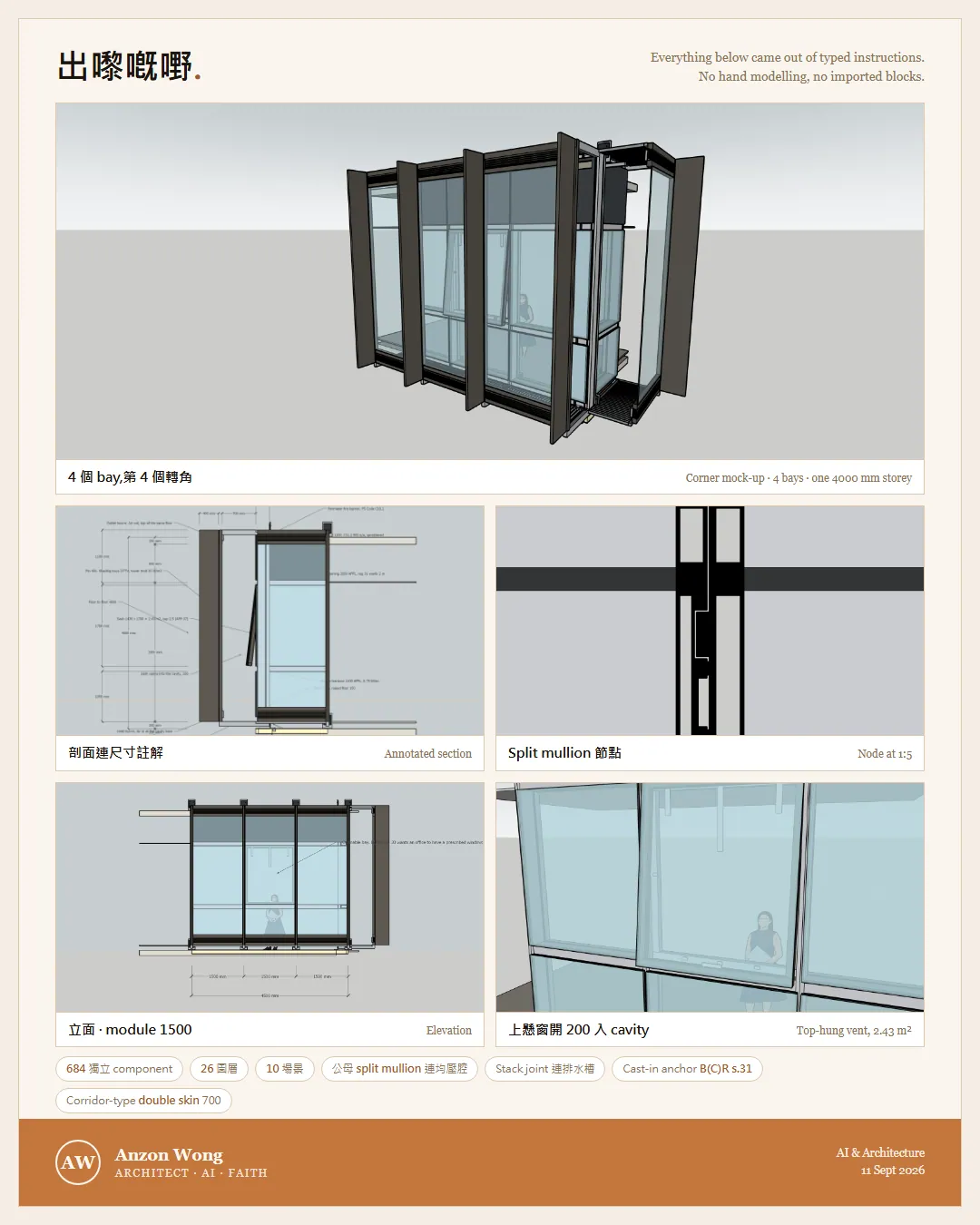
It was not answering from memory. It downloaded the Buildings Department PDFs, extracted the text, and read the clauses.
The limits, stated plainly. The 250 mm mullion depth is a preliminary figure reverse-engineered from a 150 m building height, not a design, and a real project needs the engineer's calculation. This is a study model, not a submission. Along the way it also ran the slab straight through the return facade, and only caught it by screenshotting its own work.
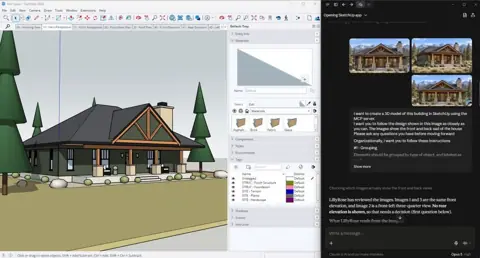
The third image is its own reasoning, copied out of the session log line for line, nothing tidied. What I could watch was not only the output but why it did each thing, including the lines where it caught its own mistakes.
I used to think AI's place in this profession was drawing faster. I have changed my mind. The two steps where it genuinely helped were reading the regulations, and repeating the same detail accurately ten times over. Neither of those should have been hand work in the first place.