The UK has 13 AI standards for schools. The United States has no standards, just a…
The UK has 13 AI standards for schools. The United States has no standards, just a contract.
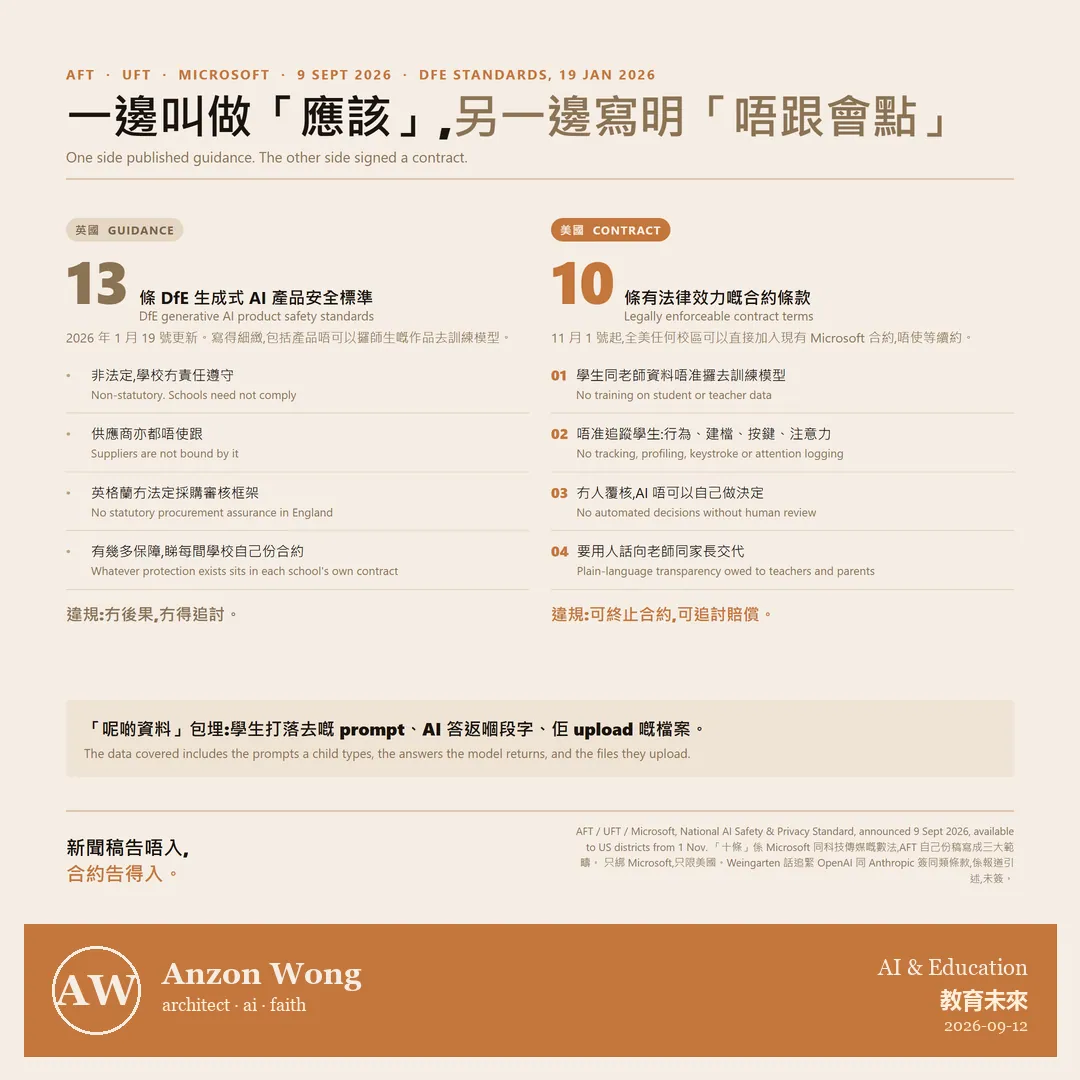
On 9 September the American Federation of Teachers, together with New York's UFT and Microsoft, announced something called the National AI Safety and Privacy Standard. The name says standard. What it actually is, is a set of legally enforceable contract terms: ten of them, which a district can bolt onto its existing Microsoft agreement from 1 November, without waiting for a renewal.
The substance:
・Student and teacher data cannot be used to train AI models, cannot be sold, cannot be repurposed. That data includes the prompts a child types, the answers the model gives back, and the files they upload.
・No tracking of students. Behavioural profiling, long-term records, keystroke logging and continuous attention monitoring are all off the table.
・No AI making decisions about a child without a human reviewing them.
・Plain-language answers owed to teachers and parents about how the tool works and what has changed in it.
Randi Weingarten's line is the one I keep coming back to: nobody else was going to do this, the federal government included, so we did it ourselves. Michael Mulgrew of the UFT put the teeth on record: districts can terminate, and districts can seek damages.
Here is why I stopped on this one. For two years, every promise made about AI in schools has been a press release. You cannot sue a press release. You can sue this.
Back to home. The Department for Education updated its generative AI product safety standards on 19 January this year. Thirteen of them, and genuinely well drafted, including a line saying a product must not take pupils' or teachers' work to train or fine-tune a model. But they are non-statutory. Schools are not required to comply, suppliers are not required to follow, and England has no statutory pre-procurement assurance framework for edtech at all.
Michael Mulgrew of the UFT put the teeth on record: districts can terminate, and districts can seek damages.
So: Britain has a good document. America has a piece of paper you can take to court.
I am not arguing we should copy it. The American version exists because the federal government would not move and a union had to, which is not a healthy way to arrive at protection. But the practical difference stands. One tells you what ought to happen. The other says what happens if it doesn't.
The caveats, as always:
・It binds Microsoft only, and only in the US. How much of what your child's school actually uses comes from Microsoft is a fair question.
・The "ten standards" figure comes from Microsoft and the tech press. The AFT's own release describes three broad areas. Same agreement, two ways of counting.
・Weingarten says the AFT is now pursuing the same binding commitments from OpenAI and Anthropic. That is reported, not signed.
・From 1 November districts may adopt it. They are not given it. Each board decides.
Which is why my question isn't when Britain will follow. It is a smaller, parent-sized one. At the next parents' evening, if I ask which AI tools the school is using, and whether anything in writing says my son's typing will not be used to train a model, is there anyone in the room who can answer me?
Have you asked? What did they say?
More in AI news
All → On the first day of a four-day conference, twenty-five education ministers in Paris…
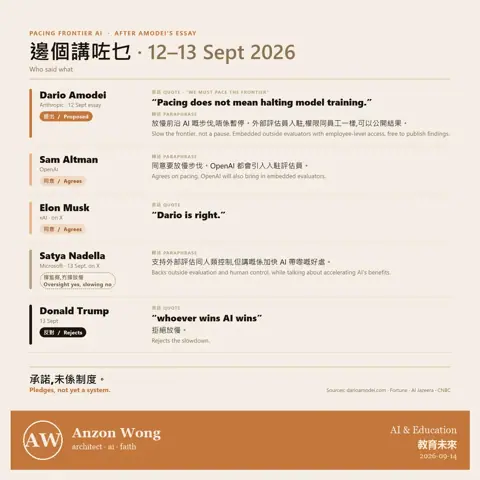 On Saturday, the head of an AI company proposed something very few companies volunteer
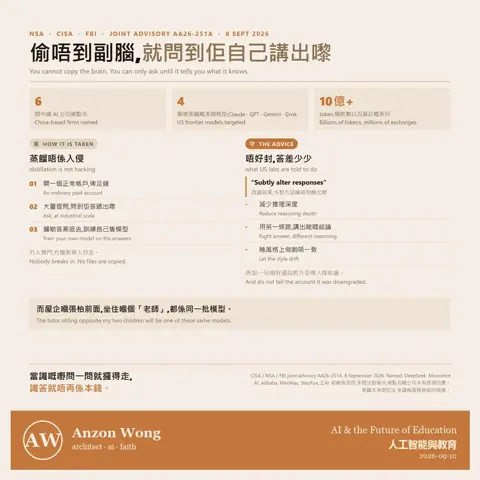 Buried in the advice the US government just gave its own AI labs is this
 Microsoft has written its AI a rulebook, and the rule that matters most is this