AI-101 Day 45: Reasoning models, thinking before answering
Day 34 covered chain-of-thought: add "think step by step" to the prompt and maths accuracy improves. Today looks similar and is a different thing.
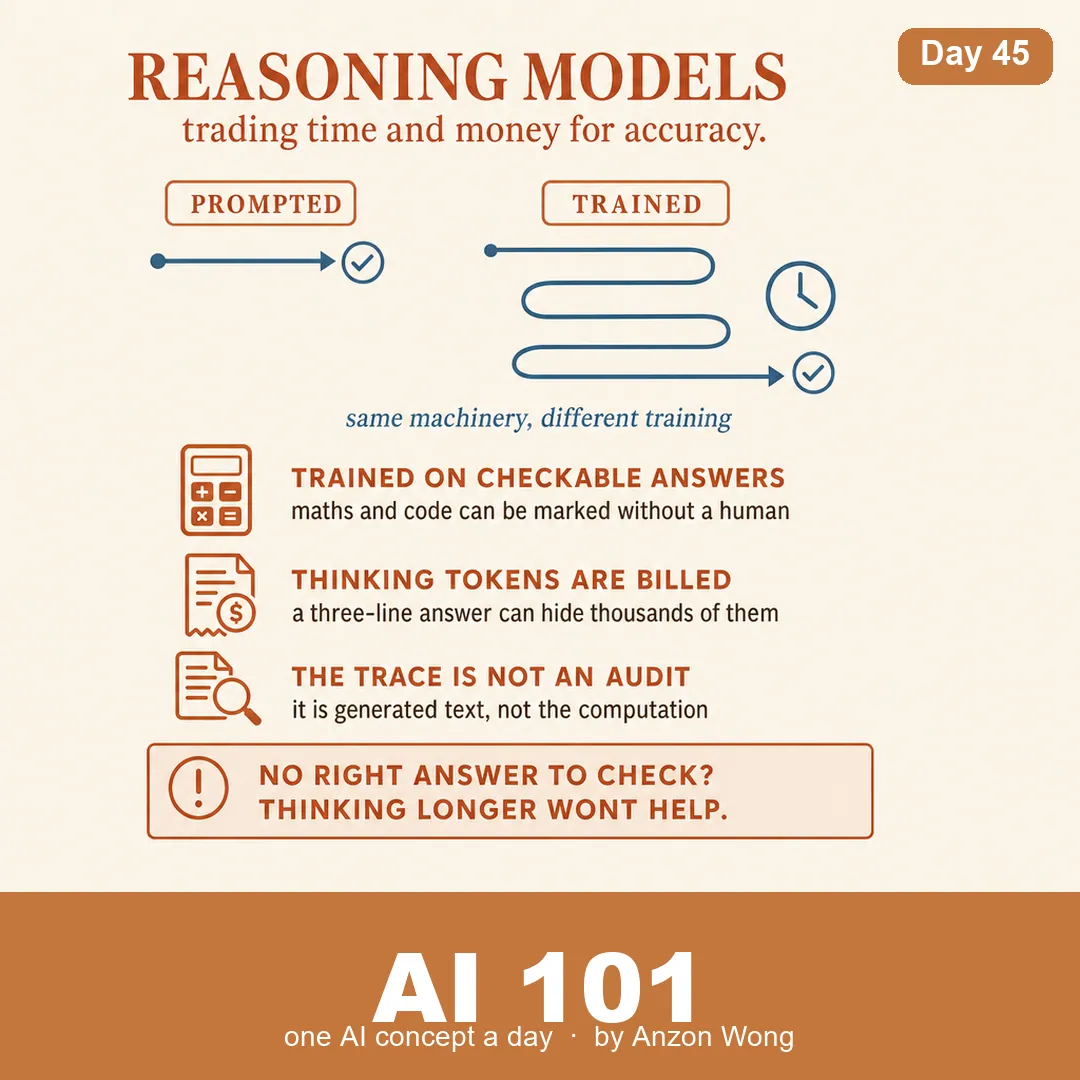
🧠 The difference: you used to ask it to think. Now it is trained to.
A reasoning model generates a long stretch of intermediate work before answering, trying, rejecting, backtracking, retrying. That's the "thinking" you see.
But be clear about one thing: there is no separate reasoning engine inside. That thinking is produced by exactly the same next-token machinery as everything else. The difference isn't mechanism. It's training.
🎯 How it's trained: on answers that can be checked.
This is the crux. Maths problems have right answers. Code either runs or it doesn't. These are verifiable outcomes, a machine can mark them without a human.
So you can use reinforcement learning: let it think, check whether the final answer was right, reinforce the kinds of thinking that got there. Do that millions of times and it learns which shapes of reasoning tend to reach correct answers.
⏱ Which opens a new axis: test-time compute. Making a model better used to mean training it bigger. Now there's a second route: let it think longer when answering. That's a dial you control, thinking budgets, effort levels. Same model, more tokens spent thinking, better results on hard problems.
💰 Those tokens are billed and they eat your context. A three-line answer can hide thousands of tokens you never see. Reasoning models are slower and dearer, not free intelligence.
Do that millions of times and it learns which shapes of reasoning tend to reach correct answers.
⚖️ When it's worth it: maths, code, multi-step logic, planning, debugging, anything where correctness is checkable.
When it isn't: summarising, changing tone, reformatting, looking something up, writing an email. There is no verifiable right answer in those, so more thinking doesn't help, you just pay more and wait longer. Using a reasoning model to draft a client letter is buying something you don't need.
⚠️ Two common misreadings:
The visible "thinking" is not a record of the computation. It is generated text like everything else. It reads like a reasoning trace, and research has repeatedly shown it can diverge from whatever actually produced the answer. Useful as an explanation; dangerous as an audit trail.
More thinking is not monotonically better. A model can reason itself out of a correct first instinct. Overthinking is real.
🔗 Put this next to Day 41 and something clicks. Benchmarks measure exactly the tasks whose answers can be checked, maths, code. Reasoning models were trained with RL on exactly those tasks. So the scores jump, while day-to-day use feels less transformed. Both are true: it really is much better at that class of problem, and much of your daily work isn't in that class.
📌 Takeaway: a reasoning model isn't a smarter model. It's a model that trades time and money for accuracy. Whether your question has an objective right answer decides whether that trade pays.