For two years we have all been bracing for the same thing: AI taking the jobs
For two years we have all been bracing for the same thing: AI taking the jobs. Last week's numbers say it hasn't happened.
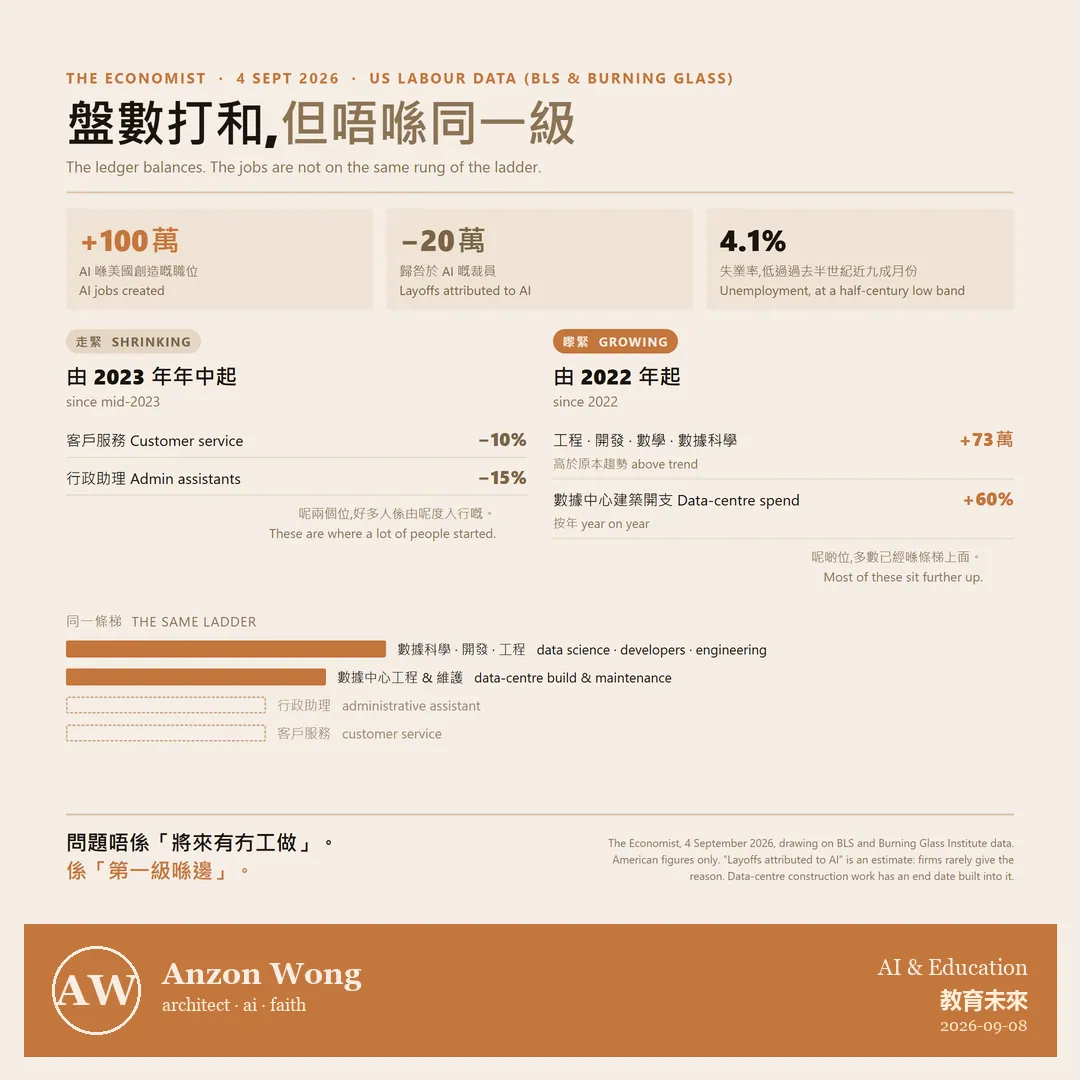
On 4 September the US Bureau of Labor Statistics reported 162,000 jobs added in August, well above expectations, with unemployment at 4.1%, a level lower than in almost 90% of months over the past half century. The same day, The Economist totted up the AI ledger: roughly a million jobs created in America, against roughly 200,000 layoffs attributed to AI.
The most surprising line was about the young. Twenty to twenty-four-year-olds were supposed to be the first casualties. The gap between their unemployment rate and the overall rate is close to a multi-decade low.
So the headline is right. The apocalypse is postponed.
But the page I stopped on wasn't the totals.
It was which jobs left, and which arrived.
Since mid-2023, customer service roles are down about 10%, administrative assistants about 15%. The fastest growth sits in the roles closest to the AI itself: engineers, developers, mathematicians, data scientists, roughly 730,000 above trend since 2022. Then a large slice of it is construction, with data centre spending up 60% year on year and maintenance wages about 40% higher than comparable work.
The gap between their unemployment rate and the overall rate is close to a multi-decade low.
The ledger balances, comfortably. But the jobs leaving and the jobs arriving sit at different heights on the ladder.
The ones leaving are, very often, somebody's first job.
I can see this clearly in my own profession. A graduate used to learn the work by doing the repetitive parts: the checking, the marking up, the first draft. I now hand that to an agent and have it back in half an hour. I am not going to pretend I don't use it, because I use it every day. But I should be honest about what that means: the bottom rung of the ladder I climbed is the rung I am helping to remove.
So I am not worried about there being no work. I am worried about where the first one is.
📌 The caveats deserve saying. This is American data, not British, and certainly not Hong Kong. "Layoffs attributed to AI" is a soft number, because almost no company writes that reason into the announcement. Data centre construction has an end date built into it. And two years is a very short read on a structural change: "no sign of it yet" is not the same as "it won't happen".
I still think the direction holds. The real question right now isn't whether our children will have work. It's how they get in.
If yours joins the workforce ten years from now, where do you think the first rung will be?