Some of the work people hand to AI outside their own job turns into a habit. Some doesn't
The stickiest: talking to customers. Of workers who first used AI for it, 54% came back to it the next month. Advertising copy, 44%. Marketing materials, 37%.
The least sticky: explaining financial information to customers, 15%. Legal research, 10%.
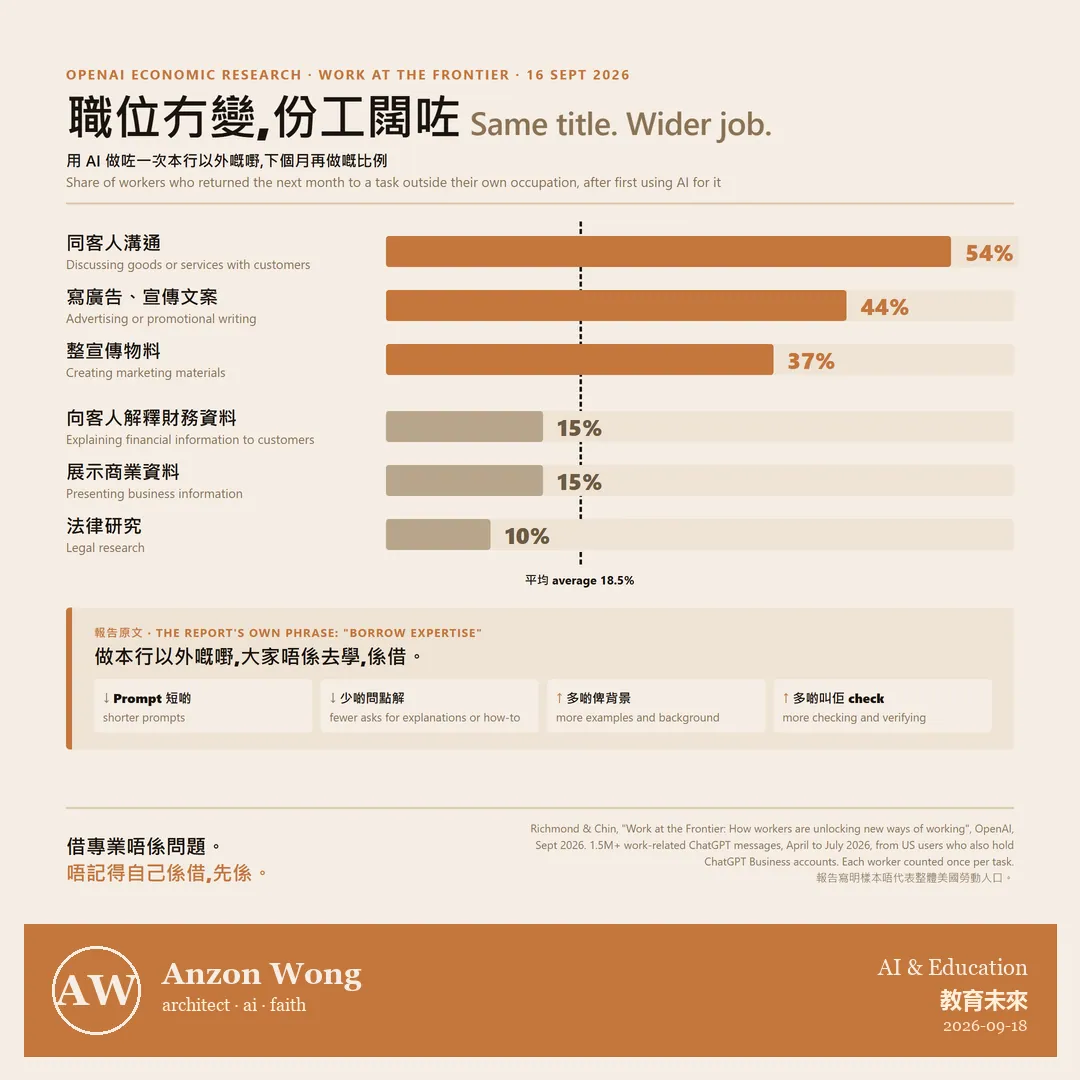
The figures come from OpenAI's Economic Research team, in a report published on 16 September. They looked at more than 1.5 million work-related ChatGPT messages from April to July this year, and asked whether people who used AI for a task outside their own occupation came back to it a month later. On average, about one time in five. Their conclusion: the job widens while the title stays the same.
The finding I find more interesting is a different one. Outside their own field, people write shorter prompts, ask less often for explanations or how-to help, give more examples and background, and more often ask AI to check something. The report's own phrase is "borrow expertise". Not learning the field. Borrowing it.
For advertising copy, borrowing is fine.
Their conclusion: the job widens while the title stays the same.
My field is different. Since October 2023, following the Building Safety Act, the Building Regulations in England require anyone doing design work to have the skills, knowledge, experience and behaviours that work needs. The law doesn't care what your business card says. It asks whether you can do it. AI sizing a beam for me doesn't make me a structural engineer.
So legal research at 10% may not mean the AI is weak. The report itself suggests it could reflect caution, or the perceived cost of getting something wrong.
A fair caveat: the sample is US users who also hold ChatGPT Business accounts, and the report says plainly it isn't representative of the US workforce.
For the children in primary school now, what their job is called may matter less than whether they can tell what they know from what they've borrowed.
Borrowing expertise isn't the problem. Forgetting that you borrowed it is.