"Provide, with the design, sufficient information
"Provide, with the design, sufficient information." That is what CDM 2015 regulation 9(4) asks of a designer: take all reasonable steps so the client, other designers and contractors can carry out their own duties.
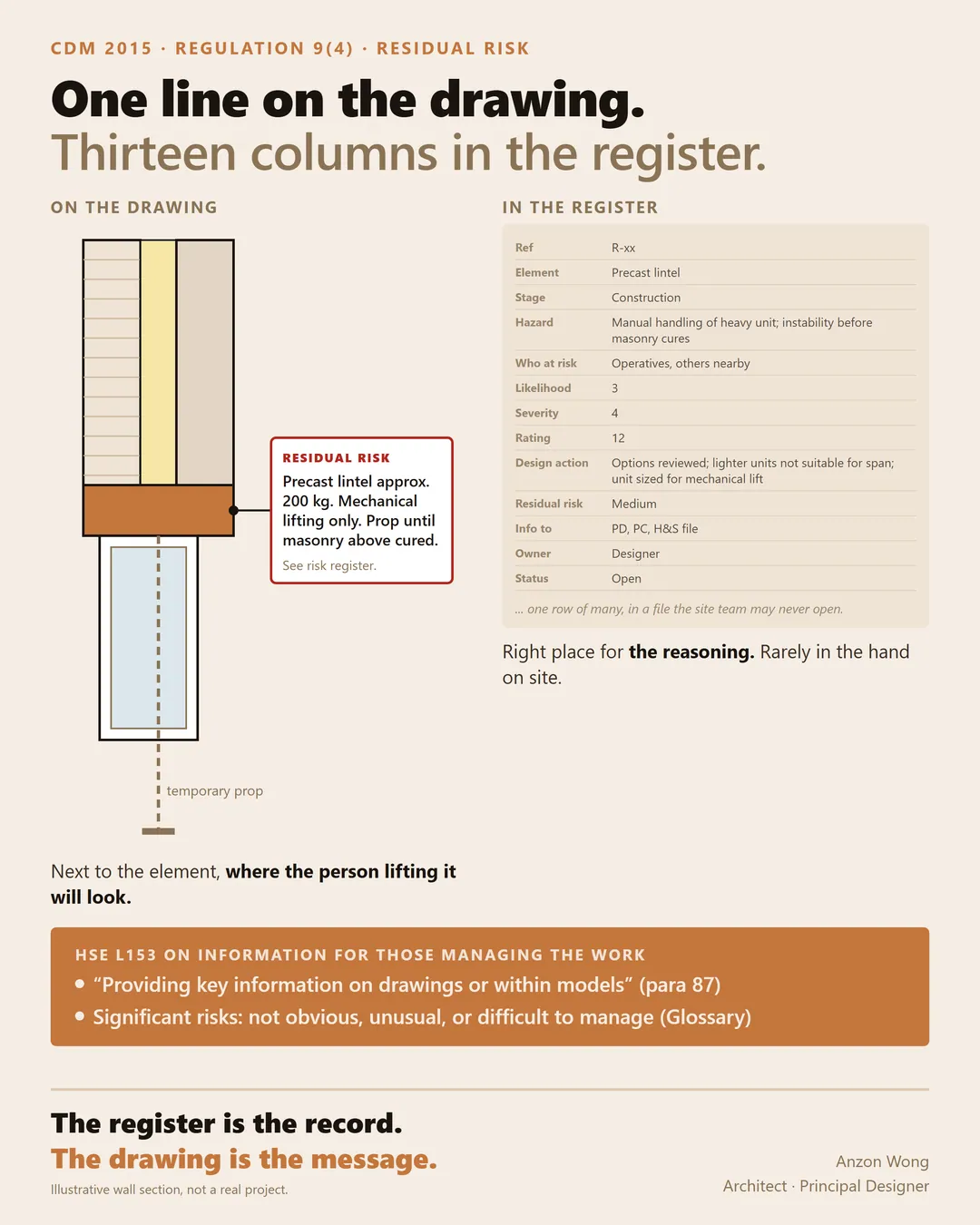
Much of that information lives in the designer's risk register. It is the right place to record the thinking. But the register is rarely what the person on site is holding. They are holding a drawing.
HSE's guidance on CDM 2015 (L153) points the same way. Where a risk cannot be designed out, the people planning and managing the work need the information to manage what remains, and the guidance says this can be done by "providing key information on drawings or within models".
It also pays to be selective. L153 describes significant risks as not necessarily the greatest ones, but those that are not likely to be obvious, are unusual, or are likely to be difficult to manage effectively. A note that repeats "work at height" on every sheet teaches people to skip notes.
A note that repeats "work at height" on every sheet teaches people to skip notes.
What makes a residual risk note on a drawing work:
1. It sits next to the element it is about, not in a general notes box.
2. It says what the hazard is and what the design assumes about managing it.
3. It is one or two lines, in plain words.
4. It points to the register for the full reasoning.
Something like: "Precast lintel approx. 200 kg. Mechanical lifting only. Prop until masonry above has cured. See risk register." The register still explains why. The drawing makes sure the person lifting it knows.
The register is the record. The drawing is the message.
Where do you put residual risk information so that it actually reaches site?
More in Building regs
All →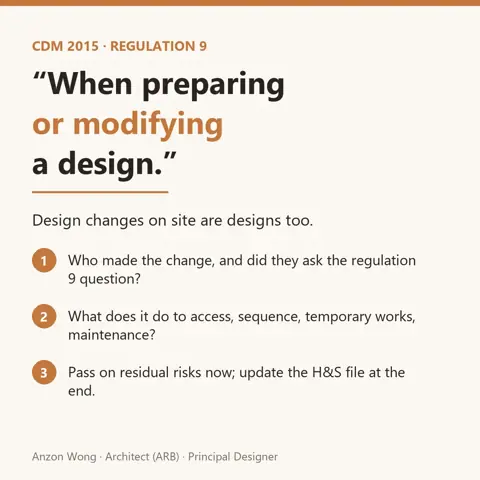 "When preparing or modifying a design." Two words in CDM 2015 regulation 9 are easy to…
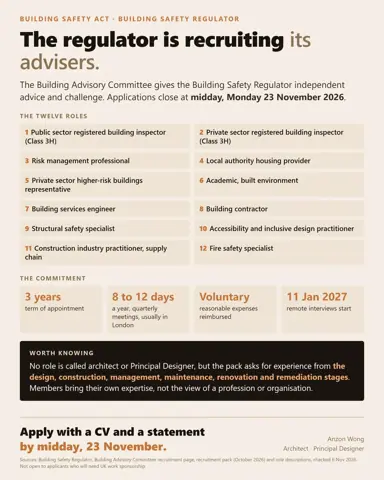 The Building Safety Regulator is recruiting members for its Building Advisory Committee
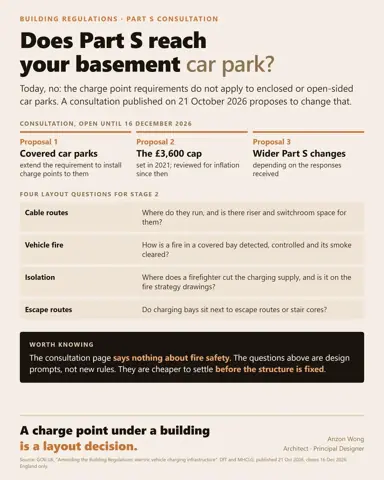 If your scheme has a basement car park, does Part S apply to it? Today, no
 Approved Document K has not had a substantial review in more than 20 years