"Not yet known. Expected by [date]." That may be the most useful line pre-construction…
"Not yet known. Expected by [date]." That may be the most useful line pre-construction information can carry.
In plain words: pre-construction information is what the client knows, or can reasonably find out, about the project and the site. It goes to every designer and contractor so they can plan the work safely. CDM 2015 makes it the client's duty, and the principal designer helps.
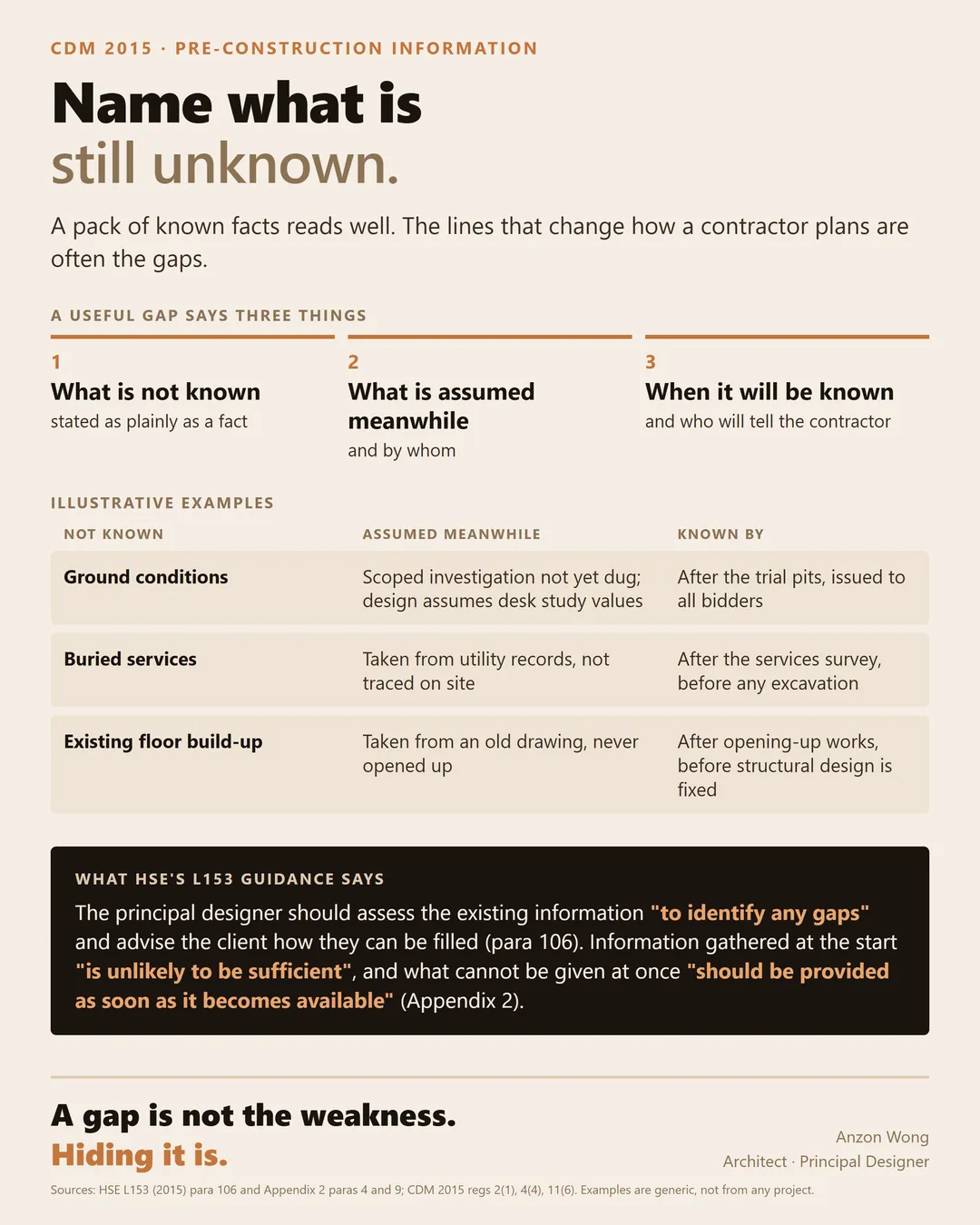
Packs tend to read as a list of known facts: surveys, drawings, an existing health and safety file. All useful. But the lines that change how a contractor plans are often the gaps:
- the ground investigation that has been scoped but not yet dug
- the buried services shown on a utility record, not yet traced on site
- the floor build-up assumed from an old drawing, never opened up
The official guidance expects these to be found and named. HSE's L153 says the principal designer should assess the existing information "to identify any gaps", advise the client how they can be filled, and help gather what is missing (paragraph 106). Appendix 2 adds that the information should be "gathered and added to as the design process progresses", because what is gathered at the start "is unlikely to be sufficient".
Packs tend to read as a list of known facts: surveys, drawings, an existing health and safety file.
The definition in regulation 2 points the same way. It covers what the client already holds and also what is "reasonably obtainable". A gap a survey could close is a gap to close, not only to record.
So a gap is not a weakness in the pack. Hiding it is. A confident pack that leaves the unknowns out passes the risk to whoever opens up first.
A gap is useful when it says three things:
- What is not known.
- What has been assumed in the meantime, and by whom.
- When it will be known, and who will tell the contractor.
The third matters because L153 also says that where information cannot be provided all at once, it "should be provided as soon as it becomes available" (Appendix 2, paragraph 9). A dated gap is something a contractor can follow up.
What does your pre-construction information say about what is still unknown?
Sources in the first comment.