Write the handover information for the person who will have to sign that it is enough
This week the Building Safety Regulator (BSR) launched a free online toolkit, "Managing building safety". It is written for the more than 4,000 principal accountable persons responsible for over 13,000 high-rise residential buildings in England.
In plain words: a high-rise residential building here is at least 18 metres or 7 storeys tall, with at least 2 homes. Once people live in it, the principal accountable person is the one legally responsible for managing its fire and structural safety.
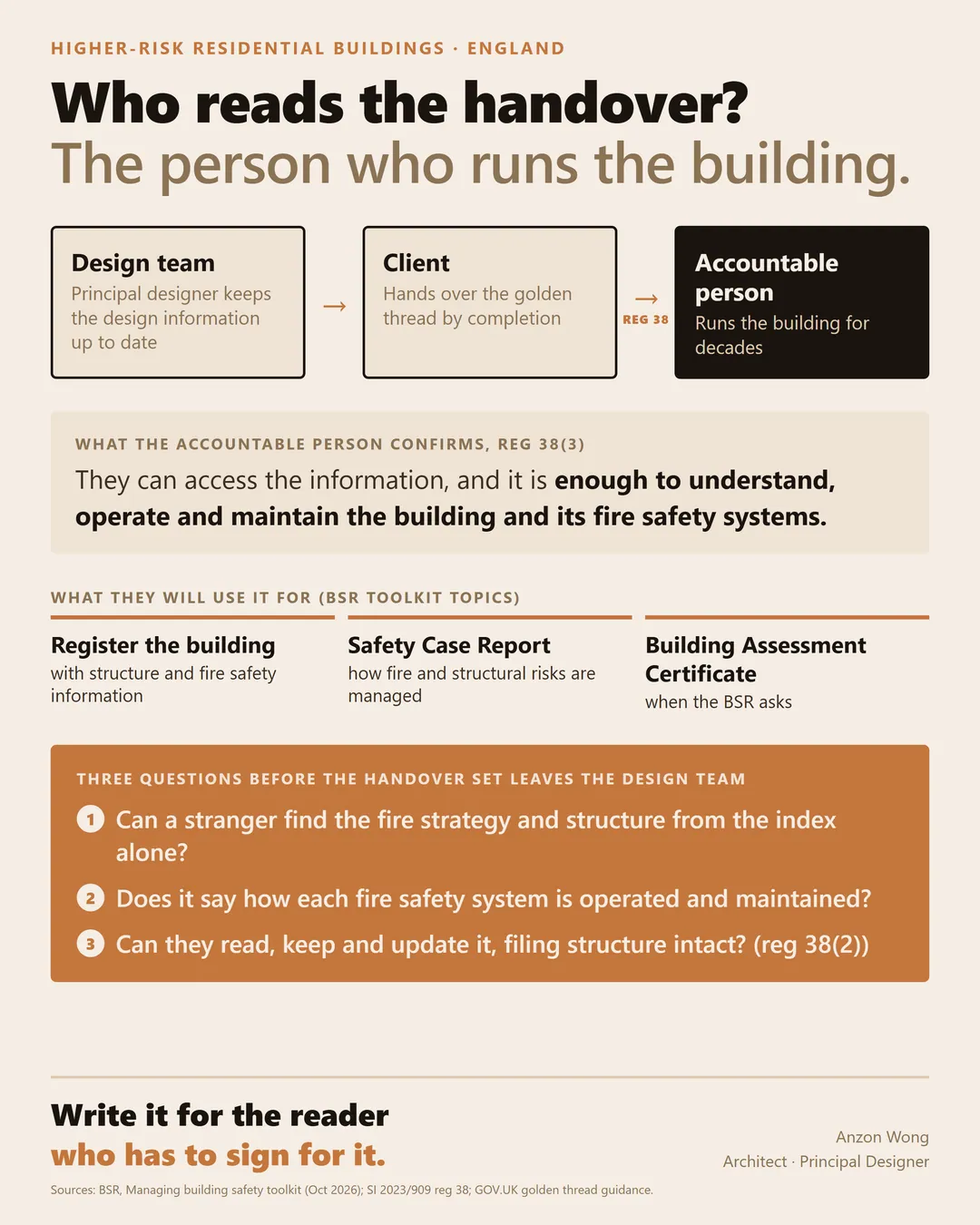
The toolkit is not written for designers. It covers registering the building, preparing a Safety Case Report, Building Assessment Certificates and engaging residents. It is still worth a design team's half hour, because it shows who reads the design information next, and what for.
The link is already in law. On a higher-risk building, the client must hand the golden thread information to the accountable person by completion (regulation 38 of the Building (Higher-Risk Buildings Procedures) (England) Regulations 2023). The golden thread is simply the building's safety information, kept digitally, up to date and in one place. The accountable person then gives the client a notice confirming the information is enough to "understand, operate and maintain the building (and the fire safety systems in it)".
The golden thread is simply the building's safety information, kept digitally, up to date and in one place.
So the reader at completion, the stage often called Gateway 3, is not only the regulator checking compliance. It is someone who will rely on that information for decades: to register the building, to prepare the safety case, and to answer the BSR when it asks for a building assessment.
Three questions worth asking of a handover set before it leaves the design team:
- Could someone who never sat in a design meeting find the fire strategy and the structural information from the index alone?
- Does it say how each fire safety system is meant to be operated and maintained, not only where it is?
- Can they read, keep and update it, with the original filing structure intact? Regulation 38(2) asks for exactly that.
GOV.UK's golden thread guidance already tells the principal designer to capture and keep the design information up to date. The toolkit is a useful reminder of where that information ends up.
What would you add to the list?
Sources in the first comment.